
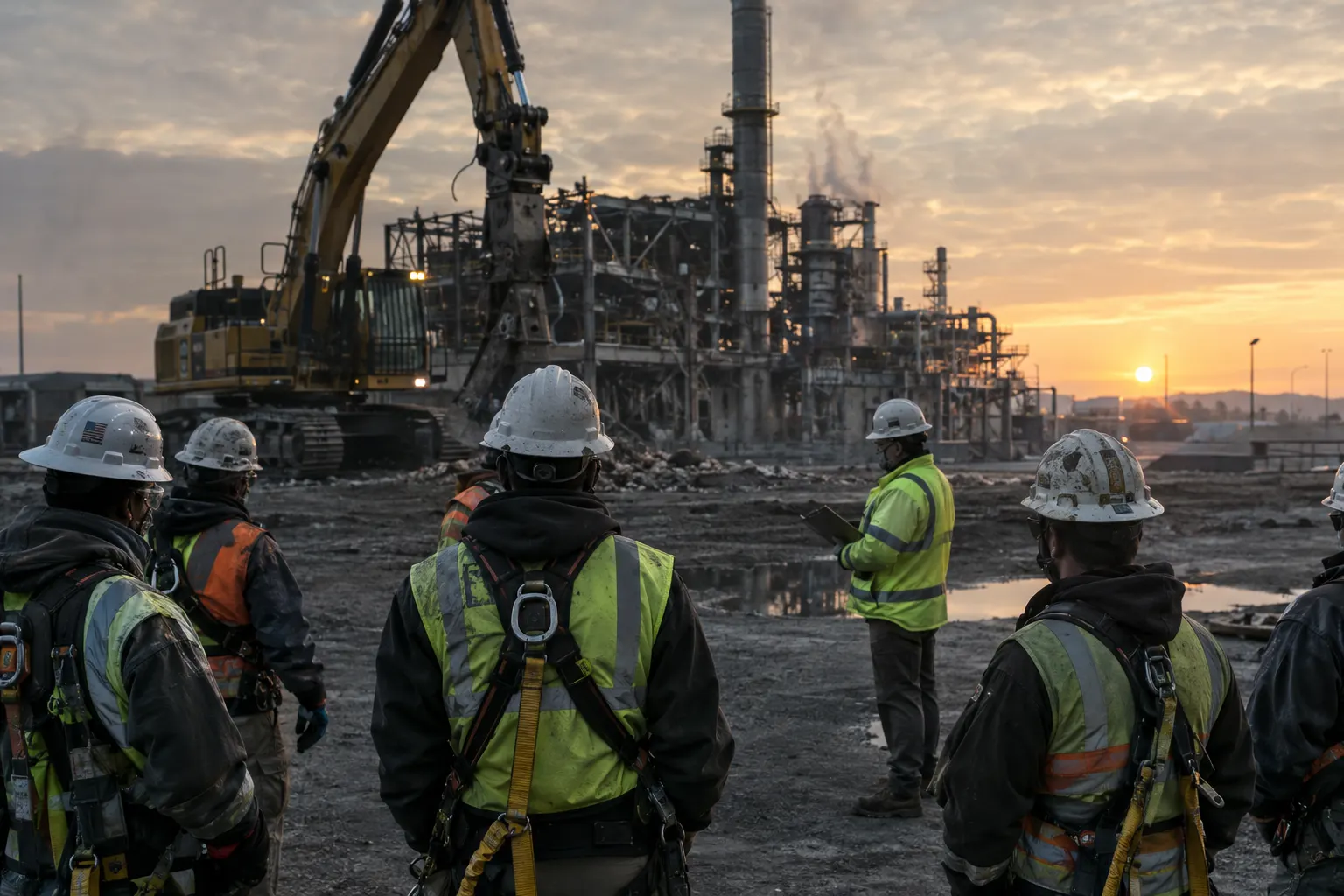
Safety
Everyone home safe, every shift.
Safety is the first line of every CCM Group work plan. It is how we protect our people, our clients’ operations and the communities around our sites, and it is how we earn the next project.
Our approach
Do it safely or not at all.
Industrial decommissioning, demolition and metals recovery involve stored energy, compromised structures, heavy lifts, hot work and hazardous materials. We do not treat those hazards as routine. Our safety system is built to identify them before mobilization, control them during the work and learn from every shift.
Two principles guide every crew: if it cannot be done safely, it will not be done; and there is always time to do it right.
01 · Safety
Safety culture
Safety starts with leadership and is owned by every person on site. Leaders set expectations, stay visible in the field and reinforce safe behavior every day. Crews are expected to speak up, to coach one another and to treat near misses as lessons worth sharing.
- Senior leadership engaged in field safety walks and pre-job reviews
- Behavior-based safety observation and coaching on every project
- Recognition for crews and supervisors who identify hazards and report near misses
- A learning culture where people can raise concerns without fear of reprisal
02 · Safety
Operations integrity framework
Our safety, health and environmental expectations are organized into a single management framework that applies to every CCM Group employee and subcontractor. It follows plan–do–check–act principles and is scaled to the risk of each project.
Leadership & accountability
Visible commitment and clear accountability for safety performance at every level.
Risk assessment & management
Job hazard analysis and engineered controls before any high-risk task.
Engineered work planning
Demolition sequencing, rigging, lift and structural-stability plans reviewed before work begins.
Personnel & training
Qualified, trained crews with competencies verified for the task.
Equipment integrity
Inspected, maintained equipment with documented pre-use checks.
Management of change
Formal review when scope, sequence, conditions or crews change.
Subcontractor management
Prequalification, orientation and oversight of every subcontractor.
Incident investigation
Root-cause investigation of incidents and high-potential near misses.
Emergency preparedness
Site-specific emergency action plans, drills and owner coordination.
Assessment & improvement
Field audits, leading indicators and continuous improvement.
03 · Safety
Life-critical rules
A short set of non-negotiable rules covers the activities most likely to cause serious injury or fatality on industrial demolition and recovery sites.
- Verify zero energy: lock out, tag out and try before work on any system
- Protect against falls at every leading edge and elevated work area
- Never enter a confined space without a permit, monitoring and an attendant
- Obtain a hot-work permit and fire watch before any cutting or torching
- Stay out of the line of fire, the drop zone and the equipment swing radius
- Follow the engineered demolition sequence and never undermine a structure
- Execute critical lifts only with an approved lift plan
- Identify and control hazardous materials before disturbing them
04 · Safety
Stop-work authority
Every person on a CCM Group site, whether employee, subcontractor or visitor, has the authority and the obligation to stop work that is unsafe, without fear of reprisal.
- 1
Intervene
Take ownership the moment something looks wrong.
- 2
Stop
Stop the task and make the area safe.
- 3
Notify
Notify the supervisor and the owner representative.
- 4
Resolve
Correct the hazard and confirm the controls.
- 5
Resume
Restart only when the risk is controlled.
- 6
Share
Share the lesson with every crew.
05 · Safety
Control of work
Every task moves through four phases so that hazards are addressed before the work starts, not after.
- 1
Plan
Scope, hazards, permits and engineered methods defined in writing.
- 2
Prepare
Pre-task briefing, isolations verified, equipment and PPE checked.
- 3
Deliver
Work performed within approved limits under direct supervision.
- 4
Learn
Post-task review captures what went well and what to change.
06 · Safety
Training & competency
Crews are trained to the hazards of the work they perform, and supervisors are trained to lead it. Training needs are matched to each scope and owner requirement.
- OSHA 10- and 30-hour construction outreach training
- HAZWOPER for hazardous-waste and remediation work
- Asbestos and lead supervisor and worker training as required
- Confined space, fall protection, rigging and signal-person qualification
- MSHA training for mining and material-processing sites
- First aid, CPR and site-specific orientation
07 · Safety
Learning from work
We measure safety with leading indicators as well as outcomes. Observations, near-miss reports, audits and post-task reviews show where risk is building so we can act before an incident occurs. Lessons learned are shared across every active project.
- Daily pre-task planning and end-of-shift reviews
- Near-miss and good-catch reporting
- Root-cause investigations with corrective actions tracked to closure
- Owner and subcontractor safety performance reviews
Responsibility